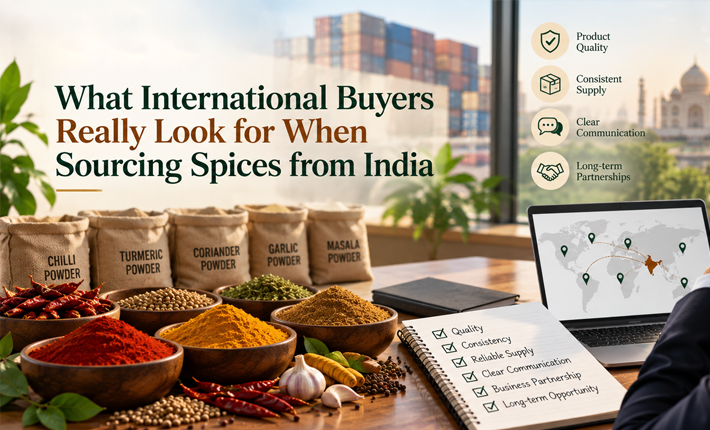
What International Buyers Really Look for When Sourcing Spices from India
When a business decides to source spices from India, the first step often appears quite simple. A buyer may already have a product in mind - perhaps chilli powder, turmeric, coriander powder, garlic powder or a particular masala, and begins looking for a suitable supplier. A quick search can bring up a long list of companies offering similar products. At first, it may seem that the decision will come down to the product and its price.
But international B2B sourcing rarely works that simply.
Once a buyer begins speaking to suppliers, more questions start coming up. What is the quality of the product? Where is it sourced from? Can the requirement be discussed in detail? Is the supplier familiar with business-to-business transactions? Will communication remain clear throughout the process? And perhaps most importantly, can the relationship continue beyond one order?
These are the questions that often determine whether a business relationship develops or ends after the first conversation.
For an Indian spice supplier, therefore, understanding what international buyers actually expect is just as important as having a good range of products. A business may have access to quality spices, but presenting those products professionally and understanding the requirements of the buyer are equally important when entering international markets.
The Product Is Only the Beginning
Indian spices have a strong presence in kitchens and food businesses across the world. Chilli, turmeric, coriander, garlic and various masala blends are familiar products, but when they become part of an international B2B transaction, the way they are sourced and presented becomes more important.
An international buyer may already know exactly which products they want. In other cases, they may be exploring options because they are entering a new market or expanding their existing product range. Their requirement could involve a single spice or several products together. They may also have particular expectations related to quantities, packaging or other product specifications.
This is why a good sourcing conversation should not begin and end with a product name.
A buyer may say they are looking for turmeric powder, but the actual requirement behind that request may be much more detailed. They may be looking for a consistent product for commercial use, a suitable quantity for their business or a long-term sourcing arrangement. Understanding that requirement allows the supplier and buyer to have a more meaningful conversation.
For businesses dealing with Indian spice products, this is an important distinction. The product may be what brings the buyer to the table, but the understanding between the two businesses is what can determine whether the conversation goes any further.
Quality Is More Than a Selling Point
When businesses discuss spices, quality is often one of the first things that comes up. This is understandable because spices can directly influence the flavour, appearance and overall characteristics of a food product.
For a commercial buyer, however, quality has another dimension: consistency.
A business may purchase a particular spice because it meets the requirements of its product today. If that same business plans to continue using the spice in the future, it needs confidence that subsequent supplies will continue to meet its expectations.
This is where quality becomes part of the relationship rather than simply part of the product description.
A buyer does not want to constantly adjust its own processes because the ingredient it receives has changed. Whether the product is chilli powder, coriander powder, turmeric powder or garlic powder, consistency can make a difference when the ingredient is being used commercially.
For an Indian spice supplier, this makes quality an important part of the overall business approach. It is not enough to say that a product is good. The supplier also needs to understand why that quality matters to the buyer and how the product fits into the buyer's own business.
This is particularly relevant in international trade, where the distance between buyer and supplier can make direct communication more challenging. A clear and professional approach from the beginning can help establish confidence.
What Does an International Buyer Actually Want?
There is no single answer to this question because every business is different. A distributor may have one set of requirements, while a food manufacturer may have another. A wholesaler may be looking at quantity and packaging, while a food business may be more focused on how a particular spice fits into its production process.
Still, there are a few things that most serious buyers are likely to consider.
The first is whether the product meets their requirements. The second is whether the business they are dealing with understands those requirements. The third is whether the relationship feels dependable enough to continue.
This is why an international buyer may look beyond a product catalogue.
A catalogue can tell them what is available. A conversation can tell them whether the supplier understands their requirement.
The difference may seem small, but in B2B trade it can be significant.
A potential buyer may have several companies to choose from. They may compare products, prices and business terms, but they are also forming an impression of the company they are speaking with. Clear communication, relevant information and a professional approach can create a much stronger starting point than a generic sales pitch.
For a B2B spice supplier, this means every enquiry needs to be treated as a business conversation rather than simply another sales lead.
Why Communication Matters in International Trade
Imagine a buyer based in another country sending an enquiry about a particular spice. They want to know about the product and have several questions before they can consider moving forward.
If the response is vague, delayed or filled with information that does not address their actual requirement, the buyer may simply move on.
This does not necessarily mean the product was unsuitable.
The problem may have been communication.
International business often involves people working across different time zones, markets and business cultures. That makes clarity even more important. Buyers want to know that the company they are dealing with has understood their requirements and can communicate with them professionally.
Good communication does not mean making elaborate promises. In many cases, it simply means listening carefully, answering relevant questions and being clear about what the business can offer.
That is one of the less visible aspects of B2B trade, but it can have a significant impact on how a potential buyer views a supplier.
Looking at the Market from the Buyer's Side
It is easy for a supplier to think about the products it wants to sell. It is more useful to think about why the buyer is looking for those products in the first place.
An international business does not usually source spices simply because it wants to buy spices. There is a business requirement behind the purchase.
Perhaps the company is supplying restaurants and food businesses. Perhaps it is distributing packaged food products. Perhaps it is working with manufacturers that require spices as ingredients. Or perhaps it is developing a new product line and looking for suitable Indian spice products.
The reason behind the purchase can influence almost every part of the conversation.
A buyer who is looking for a long-term supply relationship may have different questions from someone exploring a one-time requirement. A distributor may be interested in a broader range of products, while another business may be focused on one specific spice.
This is why understanding the buyer is an important part of international B2B trade.
The more clearly a supplier understands the requirement, the more relevant the conversation becomes.
The Role of a Spice Trading Company
This is also where the role of a spice trading company becomes interesting. A trading company operates within a larger business network. Manufacturers are responsible for producing the products, while buyers in different markets are looking for products that meet their business requirements. Between these points, there is a need for businesses that can identify products, represent them in the market and create connections with potential buyers.
The role is therefore not simply about putting products on a website. It is about creating a bridge between supply and demand.
For international buyers, this can make the process of discovering Indian spice products more accessible. Instead of navigating an unfamiliar market completely on their own, they can begin a conversation with a company that understands the products it represents and the B2B nature of the business.
This is the space in which SGD INDIA IMPEX is building its presence.
The company works with manufacturers for sourcing and focuses on marketing and trading its products at an international level. Its approach is primarily B2B, with an emphasis on presenting its product range to business buyers rather than selling directly to individual consumers.
The current range includes chilli powder, coriander powder, turmeric powder, garlic powder and masala powder.
Each of these products may serve a different requirement, but the underlying objective remains the same: to connect Indian spice products with businesses in international markets.
Why Price Should Not Be the Only Consideration
Price will always matter in business.
Every buyer has commercial considerations, and no company can ignore the financial side of sourcing. However, price alone does not always tell the full story.
Suppose two suppliers offer similar products at slightly different prices. One may initially appear more attractive because of the lower figure. But if communication is difficult, product expectations are unclear or the relationship becomes unreliable, the initial saving may not provide much value in the long run.
B2B buyers often have to consider the complete picture.
They are not only purchasing a product. They are also choosing the business they will communicate with, the process they will follow and the relationship they may need to maintain in the future.
This is especially true when sourcing internationally.
A business may spend considerable time identifying a supplier, discussing its requirements and establishing the terms of a transaction. If everything works well, that effort can become the foundation for future business. If it does not, the buyer may have to begin the entire search again.
That is why a professional B2B relationship can be valuable in itself.
Trust Does Not Happen Overnight
One of the most important things in international trade is also one of the hardest to define: trust.
A company cannot create trust simply by saying that it is reliable. Trust develops through experience.
A buyer sends an enquiry.
The supplier responds.
Questions are discussed.
The products are understood.
An initial business transaction may follow.
Then comes the real test - what happens after that?
Was the communication satisfactory? Did both sides understand the requirement? Did the overall experience create enough confidence to continue the relationship?
If the answer is yes, the next conversation becomes easier.
Over time, individual transactions can develop into a business relationship.
This is why B2B trade should not always be viewed through the lens of the immediate order. A first enquiry may represent something much larger: the possibility of a long-term connection between two businesses.
Taking Indian Spice Products Beyond the Domestic Market
India's relationship with spices is not new. Spices have been part of Indian food, agriculture and trade for generations. What has changed is the way businesses are now able to connect with markets around the world.
An international buyer does not necessarily need to travel to India to discover a potential supplier. A company can introduce its products through a professional website, communicate digitally and begin a business conversation across borders.
This creates opportunities for Indian businesses involved in the spice trade.
But opportunity also brings responsibility.
International buyers need accurate information, clear communication and a professional point of contact. Businesses looking to build their presence outside India need to understand that international visibility is only the first step. The next step is creating enough confidence for a potential buyer to start a conversation.
For SGD INDIA IMPEX, this is the purpose behind its international B2B approach.
The company aims to represent its range of Indian spice products to business buyers and develop relationships across international markets, while keeping its focus on quality and professional business communication.
A Relationship, Not Just a Transaction
There is a tendency to think of international trade in terms of shipments, orders and numbers.
Those things are certainly part of business.
But behind every transaction are two businesses trying to meet a requirement.
One has a product.
The other has a market or a business need.
The opportunity lies in bringing the two together in a way that works for both.
This is why the role of an Indian spice supplier can extend beyond simply supplying spices. The supplier becomes part of the buyer's sourcing process and, potentially, part of a longer business relationship.
The same applies to a B2B spice supplier. The objective should not simply be to complete an order but to understand the business behind the order.
And for a spice trading company, the opportunity lies in creating connections between manufacturers and buyers in different markets.
These roles may sound different, but they come together around one basic idea: business works better when there is trust between the people involved.
Where the Journey Begins
For an international buyer, the search for spices may begin with something as simple as a Google search.
Indian spice supplier.
Turmeric powder.
Chilli powder.
Indian spice products.
But what happens after that search matters.
The buyer begins comparing companies. They look at products. They read about the business. They consider whether the company appears to understand international B2B requirements. Eventually, they reach out.
That first enquiry can be the beginning of something much bigger.
At SGD INDIA IMPEX, the aim is to make that first step meaningful by presenting a focused range of Indian spice products and creating a platform for international B2B conversations.
The company works with manufacturers for sourcing and focuses on marketing and trading its products internationally. Rather than approaching the market as a direct-to-consumer retailer, its focus remains on building business connections and exploring opportunities with buyers across different markets.
And perhaps that is what international spice trading is really about.
Not simply moving a product from one country to another, but creating a connection between the people who make the product, the businesses that need it and the markets where it eventually finds its place.
For SGD INDIA IMPEX, that connection begins with quality.
It continues through communication, understanding and trust.
And it is guided by a simple philosophy that remains at the centre of the brand:


