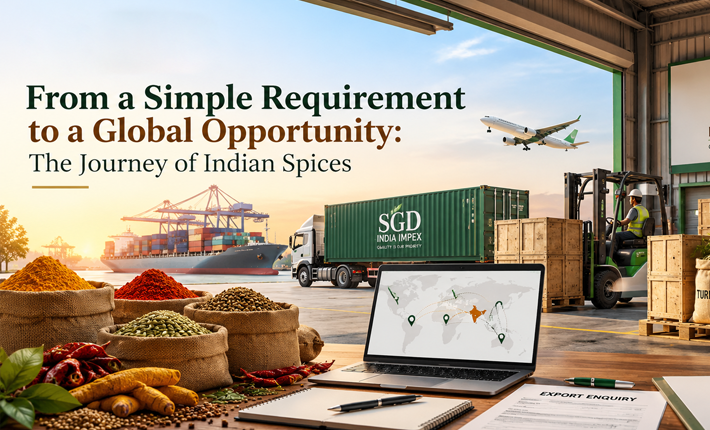
From a Simple Requirement to a Global Opportunity: The Journey of Indian Spices
It started with a simple question.
“Where can we find the right Indian spices for our market?”
For a food distribution company based outside India, it sounded like a straightforward requirement. They already knew what they wanted: good-quality chilli powder, coriander powder, turmeric powder and a few other commonly used spices. Their market had a growing demand for Indian flavours, and they were looking for a reliable source that could support their business as it expanded.
At first, the search seemed easy.
There were plenty of suppliers, manufacturers and trading companies offering Indian spice products. A few searches brought up pages and pages of options. There were different products, different packaging choices and different price points.
But after speaking to a few businesses, the team realised that finding a product was not necessarily the difficult part. Finding the right business partner was!
The Search for the Right Indian Spice Supplier
The company had been buying spices locally for some time, but its requirements were changing. It was no longer looking for small quantities for immediate use. The business was growing, and with growth came a need for more dependable sourcing. The purchasing team began making a list of what they actually needed from an Indian spice supplier.
The first requirement was obvious: quality.
The second was consistency.
They wanted to know whether the product they received in one shipment would meet the same expectations in the next. They also wanted clear communication, proper product information and someone who understood that an international B2B relationship could not be built around a single transaction.
That changed the way they looked at suppliers.
Instead of asking only, “How much does this product cost?”, they began asking more useful questions.
Where does the product come from?
Who manufactures it?
What products are available?
What quantities can be discussed?
What does the buyer need to know before placing an order?
And perhaps most importantly:
Can we build a long-term business relationship with this company?
More Than Just a List of Products
One afternoon, the purchasing team sat down with a list of products they were considering.
There was chilli powder at the top.
Then coriander powder.
Turmeric powder followed.
Garlic powder was also on their list, along with a selection of masala powders.
On paper, it was simply a product list.
But each product represented a different requirement in their business.
Chilli powder would be used in products where flavour and heat needed to remain consistent. Coriander powder was an everyday ingredient in several of their food applications. Turmeric was important not only for its flavour but also for its characteristic colour. Garlic powder and masala powders offered additional possibilities for their product range.
They realised that they were not simply looking for spices. They were looking for Indian spice products that could fit into an established business operation. That distinction mattered.
For an international buyer, purchasing spices is not always as simple as finding a product online and placing an order. There is a business conversation behind the product, a conversation about requirements, quantities, quality expectations and the market in which the product will eventually be used.
When Quality Becomes Part of the Conversation
The team had another concern.
They had previously experienced situations where the quality of a raw material varied between purchases. Even a small difference could create problems when the ingredient was being used in a commercial product.
That experience had taught them something important.
Quality is not something a business should think about only after receiving a shipment.
It needs to be part of the conversation from the beginning. For a business purchasing spices, consistency can influence everything from the final product to customer expectations. When an ingredient is being used regularly, a buyer needs confidence in the product and in the business supplying it.
This is particularly relevant when dealing with international markets.
A buyer and supplier may be located in different countries. Their businesses may operate in different environments and their markets may have different expectations. Communication, therefore, becomes just as important as the product itself.
The team added another point to their list:
We need a supplier who understands B2B business.
Understanding the B2B Difference
A retail customer usually knows what they want to buy.
They see a packet of turmeric or chilli powder, check the information on the package and make a purchase.
A business buyer works differently.
The quantities are different. The requirements may be different. The decision-making process can involve more than one person, and the purchase may be connected to an ongoing business operation.
This is where a B2B spice supplier plays an important role.
The relationship is not simply about selling a product. It is about understanding the buyer's requirements and creating a professional business connection. For a trading company working in the international market, this means being clear about the products it represents and understanding the importance of reliable sourcing and communication.
The purchasing team began to see the process differently.
They were not searching for the cheapest product they could find.
They were looking for a business relationship that made sense for both sides.
Looking Towards India
India was a natural place to look.
The country has a long association with spice cultivation, processing and trade. Indian spices have travelled far beyond the country's borders and have become familiar ingredients in cuisines around the world.
But for the purchasing team, the appeal was not simply the reputation of Indian spices.
They wanted to understand what was available to them as an international buyer.
Could they source chilli powder?
Could they explore coriander and turmeric?
What about garlic powder?
Could they discuss different masala products based on their requirements?
The search became less about finding one product and more about understanding the possibilities.
And that is often how an international business relationship begins.
Not with a large order.
Not with a long contract.
But with a conversation.
A Conversation That Can Lead Somewhere
Imagine a buyer reaching out to a trading company for the first time.
The buyer explains what they are looking for.
The trading company asks questions.
What products are you interested in?
What is your market?
What quantities are you considering?
What are your expectations?
Instead of immediately pushing a product, the conversation becomes an opportunity to understand the requirement. That approach may seem simple, but it can make a considerable difference.
International B2B trade depends on relationships. Businesses need to know who they are dealing with, what products are being represented and whether both sides have a clear understanding of the requirement.
For a company involved in spice trading, the ability to connect manufacturers with international business buyers becomes an important part of its role.
This is where SGD INDIA IMPEX enters the story.
Connecting Manufacturers with International Markets
SGD INDIA IMPEX follows a B2B-focused model.
The company sources its products from manufacturers and focuses on marketing and trading them at an international level. Its role is not positioned around direct consumer sales. Instead, the focus is on connecting products with business buyers and developing opportunities in international markets.
The company's product range includes chilli powder, coriander powder, turmeric powder, garlic powder and masala powder.
For an international buyer, this creates a starting point for a business conversation.
The requirement may begin with one product, but the relationship can eventually develop around a wider range of products depending on the buyer's needs.
This is also why the company's approach is centred on B2B trade rather than simply displaying products for individual consumers.
The purpose of presenting the products online is to introduce the business, showcase its product range and make it easier for potential business partners to understand what SGD INDIA IMPEX is involved in.
The website becomes more than a catalogue. It becomes a first point of contact.
The First Order Is Only the Beginning
Let's return to our buyer.
After several conversations, they finally decide to move ahead with an initial requirement.
The order is not the end of their search.
In fact, it is the beginning of a new phase.
The buyer will now evaluate the experience. Was the communication clear? Did the product meet expectations? Was the process handled professionally? Would they be comfortable discussing another requirement in the future?
This is how B2B relationships are built.
One interaction leads to another.
One order creates the possibility of a second.
And gradually, a business relationship begins to take shape.
This is particularly important in international trade, where trust cannot be assumed simply because two businesses have exchanged contact details.
It has to be developed over time.
Why the Human Side of Trade Still Matters
Technology has made it easier than ever to discover suppliers around the world.
A buyer can search for a product in a few seconds. A company can introduce its products to international audiences through a website. Businesses can communicate across countries without being in the same room.
Yet the human side of trade has not disappeared.
A business still wants to speak to someone who understands its requirements.
A buyer still wants clear answers.
A supplier still needs to know what the customer is looking for.
And both sides still need to trust the information being shared.
That is why a professional online presence is important for a B2B company.
A website may be the first place a potential buyer discovers the business, but what matters next is whether the information creates enough confidence for that buyer to start a conversation.
From Indian Spices to International Opportunities
The story of Indian spices is much larger than a product catalogue.
Behind every product is a network of manufacturers, traders, buyers and businesses working across markets.
Chilli powder may begin with a manufacturer in India and eventually become part of a food product sold thousands of kilometres away.
Turmeric may travel from an Indian source to a business serving an entirely different market.
Coriander, garlic and masala powders can follow similar journeys.
The distance between the source and the final market may be considerable, but the business relationship that connects them begins with something very simple:
a requirement and the right conversation.
For companies such as SGD INDIA IMPEX, this creates an opportunity to play an important role in the journey of Indian spice products.
The focus is on sourcing from manufacturers, presenting the products to international markets and building B2B connections with businesses that are looking for suitable Indian spice products.
A Simple Philosophy
As the story of our imaginary buyer comes to an end, there is one thing that remains clear.
They began their search thinking they were simply looking for spices.
What they actually needed was a reliable business connection.
They needed products that suited their requirements, a company that understood the B2B environment and a relationship that could potentially continue beyond the first order.
That is the larger opportunity in international spice trading.
It is not simply about taking a product from one country to another.
It is about understanding markets, connecting businesses and creating relationships that can grow with time.
For SGD INDIA IMPEX, that journey is guided by a straightforward philosophy:
Quality is Our Priority.
From chilli powder and coriander powder to turmeric, garlic and masala powders, the company aims to connect Indian spice products with businesses beyond India's borders.
And perhaps every international business relationship begins in much the same way as our story did, with a simple question:
“Where can we find the right Indian spices for our market?”
Sometimes, the answer is not just about finding the right product.
It is about finding the right partner to take that product forward.


